Adverb Of Time Place And Manner : Adverbs of Manner, Place and Time Worksheet : Neatly, slowly, quickly, sadly, calmly, politely, loudly, kindly, lazily.. These adverbs indicate a situation dealing with time. Adverbs of manner or place are usually positioned at the end of the sentence Yesterday, now, then, tomorrow, today, late, early, tonight, again, soon etc adverbs of. Manner adverbs tell us how something happened. Neatly, slowly, quickly, sadly, calmly, politely, loudly, kindly, lazily.
Adverb clauses (adverbial clauses) are groups of words with a subject and a verb that function as adverbs. Adverbs of manner or place are usually positioned at the end of the sentence ( tomorrow is an adverb of time.) Instead, never mind the fancy words. An adverb of time provides more information about when a verb takes place.
Here is another worksheet for your students to practice Kinds of Adverbs. It has EXERCISES on ... from i.pinimg.com An adverb phrase consists of an adverb plus any modifiers. However, manner adverbs, frequency adverbs, time adverbs, degree adverbs and place adverbs are the most commonly used. Adverb clauses (adverbial clauses) are groups of words with a subject and a verb that function as adverbs. There are many different types: An adverb of time provides more information about when a verb takes place. Adverbs of time, place and manner. Despite the subtle differences between these 5 types of adverbs, let's hear some adverb examples. Adverbs of place/direction that indicate place/direction of the action in the sentence.
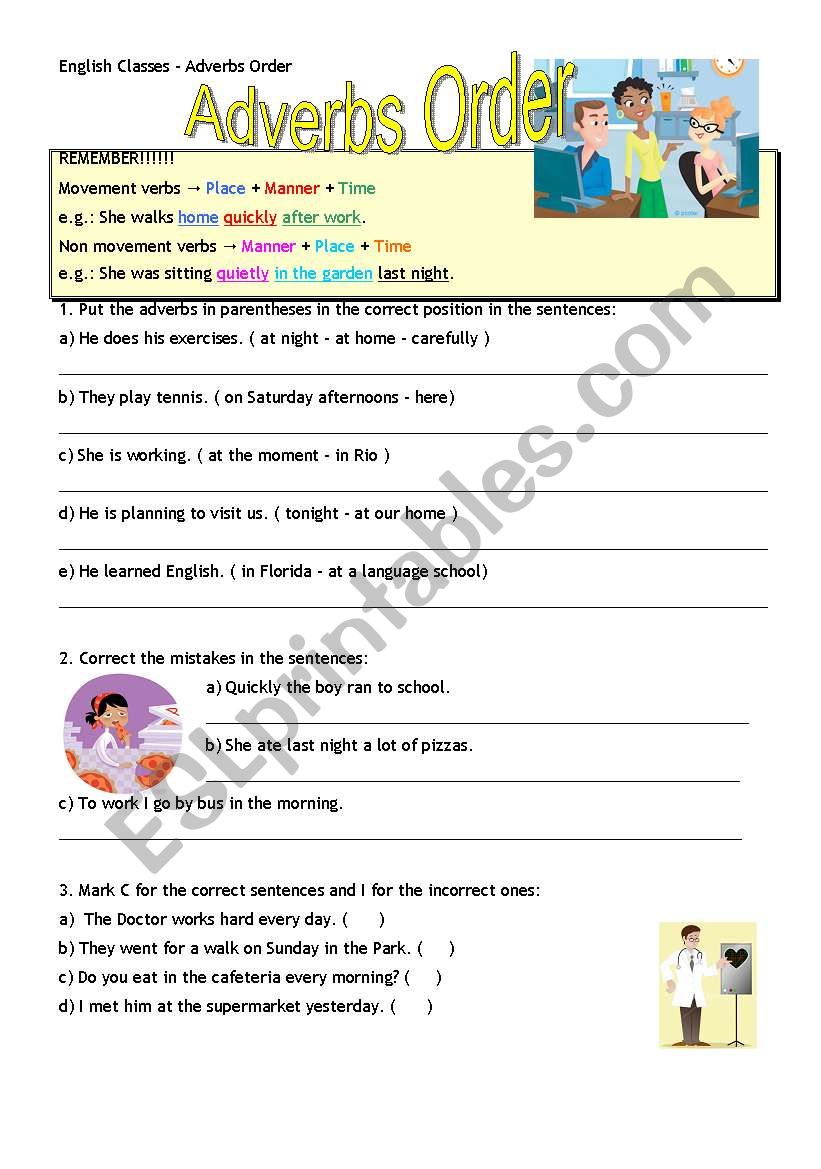
When there is more than one of the three types of adverb together, they usually go in the order:
Adverbs of place/direction that indicate place/direction of the action in the sentence. Adverb clauses (adverbial clauses) are groups of words with a subject and a verb that function as adverbs. Time, place, manner, and frequency are just the 'fancy' terms for simple answers. Adverbs of manner or place are usually positioned at the end of the sentence However, manner adverbs, frequency adverbs, time adverbs, degree adverbs and place adverbs are the most commonly used. It tells when, where, and how an action is performed or indicates the quality or degree of the action. Adverbs of manner, place and time usually come in end position: Adverbs of time are usually placed at the beginning or end of a examples of adverbs of manner: The young soldier folded his clothes neatly in a pile at the. Yesterday, now, then, tomorrow, today, late, early, tonight, again, soon etc adverbs of. Early, earlier, late, later, now, then, today, tomorrow, and yesterday. For adverbs of time, place, manner, frequency, and degree, we've provided examples that we use in everyday english. Neatly, slowly, quickly, sadly, calmly, politely, loudly, kindly, lazily.
Despite the subtle differences between these 5 types of adverbs, let's hear some adverb examples. Adverb clauses (adverbial clauses) are groups of words with a subject and a verb that function as adverbs. Angrily, happily, easily, sadly, rudely, loudly, fluently, greedily, etc adverbs of place: The verb here is work and the adverb is fast and the question being asked is: Yesterday, now, then, tomorrow, today, late, early, tonight, again, soon etc adverbs of.
Adverbs order - manner place time - ESL worksheet by Lihgf from www.eslprintables.com Contrast, purpose, cause, effect, comparison, time, place, manner, and condition. Angrily, happily, easily, sadly, rudely, loudly, fluently, greedily, etc adverbs of place: However, manner adverbs, frequency adverbs, time adverbs, degree adverbs and place adverbs are the most commonly used. Adverbs of time are usually placed at the beginning or end of a examples of adverbs of manner: ( quietly is an adverb of manner.) we'll leave tomorrow. In other words, they describe the manner , place , or time of an action. An adverb is a word that describes a verb, adjective, other adverb, or clause.. Despite the subtle differences between these 5 types of adverbs, let's hear some adverb examples.
It tells when, where, and how an action is performed or indicates the quality or degree of the action.
You start off mannerslowly timein the beginning. An adverb is a word/a set of words that modifies verbs, adjectives, and other adverbs. All things considered, adverbs are common parts of speech and sentence structure. Don't miss our complete guide to adverb clauses with definitions. Adverbs of manner, place and time usually come in end position: For adverbs of place and manner, i believe there is not a general order that is usually followed in english. ( tomorrow is an adverb of time.) It tells when, where, and how an action is performed or indicates the quality or degree of the action. The young soldier folded his clothes neatly in a pile at the. In other words, they describe the manner , place , or time of an action. Instead, never mind the fancy words. Adverbs of manner or place are usually positioned at the end of the sentence Adverbs of place will be associated with the action of the verb in a sentence, providing context for direction, distance adverbs of time, while seemingly similar to adverbs of frequency, tell us when something happens.
For adverbs of time, place, manner, frequency, and degree, we've provided examples that we use in everyday english. Early, earlier, late, later, now, then, today, tomorrow, and yesterday. In other words, they describe the manner , place , or time of an action. Adverbs of place/direction that indicate place/direction of the action in the sentence. When there is more than one of the three types of adverb together, they usually go in the order:
Here is another worksheet for your students to practice Kinds of Adverbs. It has EXERCISES on ... from i.pinimg.com You start off mannerslowly timein the beginning. Yesterday, now, then, tomorrow, today, late, early, tonight, again, soon etc adverbs of. Adverb clauses (adverbial clauses) are groups of words with a subject and a verb that function as adverbs. Angrily, happily, easily, sadly, rudely, loudly, fluently, greedily, etc adverbs of place: Adverbs of manner, place and time usually come in end position: Time, place, manner, and frequency are just the 'fancy' terms for simple answers. These adverbs tell about the manner of the action being done, whether it is done happily or haltingly etc. An adverb of time provides more information about when a verb takes place.
An adverb is a word that describes a verb, adjective, other adverb, or clause..
However, manner adverbs, frequency adverbs, time adverbs, degree adverbs and place adverbs are the most commonly used. Despite the subtle differences between these 5 types of adverbs, let's hear some adverb examples. Consider this google ngram showing that stay at home alone beats stay alone at home, but not overwhelmingly. An adverb is a word that describes a verb, adjective, other adverb, or clause.. ( tomorrow is an adverb of time.) Adverbs of time do go last, something both your references agree on. Don't miss our complete guide to adverb clauses with definitions. Adverbs of time are usually placed at the beginning or end of a examples of adverbs of manner: Contrast, purpose, cause, effect, comparison, time, place, manner, and condition. Adverbs of manner, place and time usually come in end position: In other words, they describe the manner , place , or time of an action. Yesterday, now, then, tomorrow, today, late, early, tonight, again, soon etc adverbs of. These adverbs indicate a situation dealing with time.
( tomorrow is an adverb of time) adverb of time. Contrast, purpose, cause, effect, comparison, time, place, manner, and condition.